

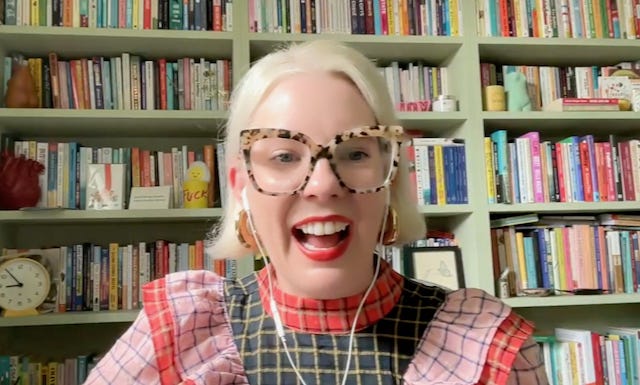
It may seem counterintuitive that Emma Gannon decided to self-publish the most recent two of her 10 books. But expect to see it more, she said.
“I think that this is going to be a bigger trend,” Gannon said. “I think more authors are going to say, ‘Actually, I think I want more input; I want to choose my cover; actually, I want to choose the font on the pages.’”
Gannon discussed her new self-publishing experience during a recent interview with London Writers’ Salon.
Gannon has written eight non-fiction books and two novels, with more projects underway. Her latest book, A Creative Compass, aims to help readers break free from external pressure and discover joyful creativity.
Her second novel, Table for One (2025), was selected as People magazine’s ‘Fiction of the Week.’
Gannon also writes “The Hyphen,” a Substack newsletter with more than 83,000 subscribers. And she hosts creativity retreats around the world.
Besides self-publishing, Gannon discussed A Creative Compass, rediscovering her creativity post-burnout, and more.
Below are highlights of some key topics.
Gannon is becoming a self-publishing proponent
Gannon has now self-published two books: A Creative Compass and A Year of Nothing.
While Creative Compass was traditionally published in the UK, she decided to self-publish in the U.S. after rejections from 20 traditional publishers.
“Because I’m not famous enough, essentially, in America, was the answer,” Gannon said. “But I knew it was a good book because it had been published in the UK, and also I could see that people were resonating with it.”
So, she bought the rights from Penguin and now distributes the book in the U.S. herself. That means she can see all of the sales data — difficult to obtain from traditional publishers — and get a larger portion of each sale.
She worked with IngramSpark to distribute the book into bookstores. It’s also available on Amazon and as an e-book.
A Year of Nothing was her experiment in the self-publishing world, she said. In the first six months of it being on sale, she invested £13,000 ($17,181), and it made £26,000 ($34,362).
“You obviously have to have the finances to invest up front in a self-published book. But instead of getting an advance, I just made the money back.”
Whether traditionally or self-published, authors have to handle much of their own marketing.
“It’s always been a slightly disappointing experience, and that’s just the reality. So I prefer to do it myself now, and then also own all my work.”
She added: “I don’t think the traditional markers of success in big retail spaces really move the needle as much as we think they do. It definitely looks good, but I don’t know how many books are really being sold.”
Burning out and rediscovering creativity
Just after finishing The Success Myth, Gannon hit a wall.
After a panic attack and overwhelming feelings of dread, she had to take a break.
“I still can’t really make sense of it. My brain just imploded on itself, and I couldn’t do anything anymore,” she said.
She spent the next year slowing down, stepping back from productivity, and relearning to enjoy the little things. That’s what helped her rediscover her creativity, which was the basis for A Creative Compass. She chronicled the year off in A Year of Nothing.
“I believe that burnout can only really be healed through play and joy and remembering what you love about life. My creativity is actually at an all-time high at the moment. I’m working on another book at the moment; I’m writing every day; I’m feeling great.
“It was the tiniest things that really made me feel the most creative. Waking up, making a coffee, getting outside if you can … what I want to wear, flowers that I want to put in a vase. I’m a massive fan of buying secondhand trinkets … I read every day. I write a lot in The Creative Compass about being very intentional with who I spend my time with, who my friends are.”
“I don’t read the news very often at all, and I felt bad admitting that for a long time. I don’t anymore. I can find out the news in other ways … and still stay very informed.”
“I think A Creative Compass genuinely unlocked something for me … It made me realize that I don’t need to know what I’m going to do next year. I don’t need to know what I’m going to do in five years’ time. I know that I’m following my intuition, and that’s enough.”
The process for developing A Creative Compass
Gannon said she’s always wanted to write a book about creativity, particularly after reading Big Magic by Elizabeth Gilbert and The Artist’s Way by Julia Cameron.
“I was a bit nervous about it because I always imagined myself in my 70s writing a creativity book, and I felt like I can’t do it now … And then I looked at the last 10 years, and I’m writing my tenth book — and it’s not about numbers; it really isn’t. But something is working. Something is flowing.”
“I wrote this book quite quickly. I would say that I knew the structure of this book before I knew what I was going to put in it … Once I’ve got a theme, I’m good to go.”
“I gave myself six months to be like a squirrel gathering nuts … I don’t overthink it; I don’t try and make it neat. Post-It notes, Google Docs, newspaper cuttings, a quote that someone said to me a month ago that I remembered was really good, paragraphs that have spoken to me, poems that I like — I just gathered all of it.”
Pushing through to finish a project
Gannon had a particularly tough time writing her second novel, Table for One. Now, it’s in WHSmith airports all over the UK.
“I’m really proud of it. But it was awful to write. It was terrible. It broke me in half. It was such an uphill struggle.”
“I also think that some books are just really hard and some books are really easy. Some books I’ve written in a month, some books I’ve written in four years. I just think they’re different energies and they’re different processes. This is why I’m sort of against the, ‘This is how I write a book,’ because they’re all different.”
“I fundamentally believe that there will never be enough books in the world. Your book is needed. You are adding to the pile.”
“Some things you obviously do abandon because they don’t work, and that’s really sad, and you have to kind of grieve the fact that it didn’t work.”
Why Gannon won’t pre-sell a book again
Table for One was Gannon’s second in a two-book deal with HarperCollins. That was her last time pre-selling a book, she said.
“My psyche doesn’t like … pre-selling things when I haven’t gone through the creative process myself.”
“Ann Patchett famously talks about this, and she never, ever sells things in advance. She always writes the book she wants to write and then just gives it over and says, ‘Do you want it?’ That is something I will always do now. I will never, ever pre-sell a book before it’s finished.”
“Because without the publishers meaning to — it’s very well-intentioned — but they meddle with it. They kind of think it’s a shared book, and I’m like, ‘No, no, no, it’s my book.’”
Shed people-pleasing and write anyway
Women often discard writing in lieu of taking care of others’ wants and needs, she pointed out, but she urges them to carve out time for themselves.
“I think it’s underplayed how much people-pleasing ruins our lives. We are well-intentioned … But people-pleasing at the end of the day is really destructive to ourselves, to our relationships.”
“I feel like I owe it to the women that came before me to try and shed it and expose it for what it is”
“All we’re asking for is a few hours to write every day or every week … It is terrifying to put those boundaries in place, but once you do it, it’s the best feeling in the world.”
Tricking yourself into writing
Sometimes writers just don’t feel like writing. She said the way she tricks her brain into writing anyway is to treat it as the opposite of work.
“Writing is my job; I can do it whenever I want at this point. I still choose to have this little Sunday afternoon cafe moment where I just take myself to a cafe and get a really nice coffee.”
“No one is asking me to be there. It’s the opposite of going to work. It’s like I’m choosing to go to a cafe for an hour on a Sunday, and I love it, and I treat myself to whatever I want from the bakery section, and I just sit there and I work on my little new book for fun. And it’s such a hobby.”
“Even though I know this probably will be something that is read, I have to trick myself into, ‘This is just fun. This is just for me. This is no-pressure.’”
Upcoming projects
Now that Gannon is feeling creative again, she has some new projects underway.
“In my new book that I haven’t announced — and I can’t say the title or anything — is about a marriage sabbatical that I took two years ago where I took a month out of my life to just be on my own for the first time since I was, like, 21.”
“I’m working on a book at the moment about permission for women, this idea of what does it mean to give yourself permission to do anything you want to do. Whether it’s going on holiday by yourself for a week, leaving your kids at home for a month … whether it’s write the book, whether it’s leave your job.”